
Mentors: Theresa Windus and Qi Li
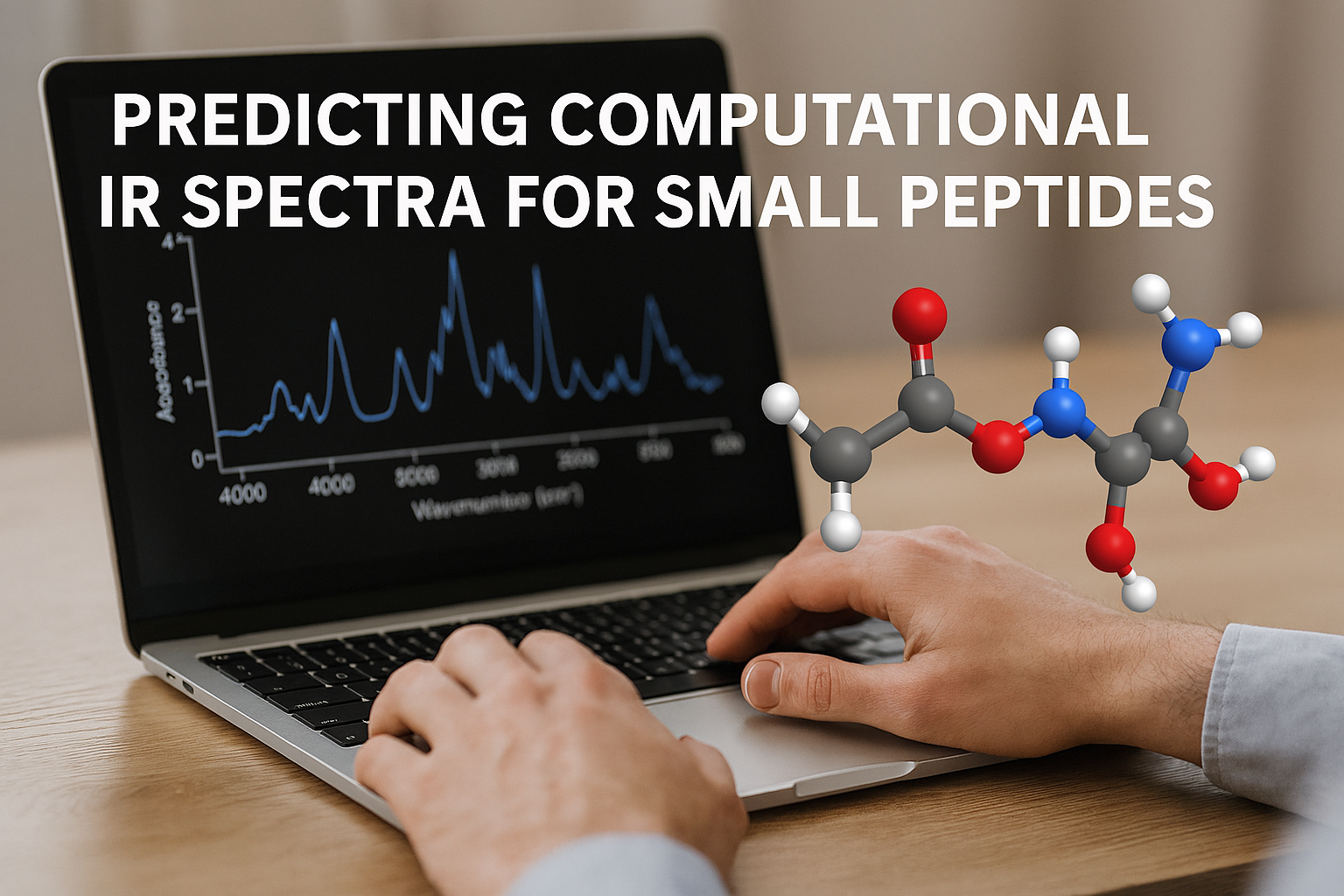
In Chemistry infrared (IR) spectra are an important tool for understanding chemical structure. This is because IR spectra serve as a sort of “molecular fingerprint,” i.e., each molecule has a unique IR spectrum. In turn, chemists can tell what molecules are present in a compound based on the IR spectra of the compound. Furthermore, this “fingerprint” becomes distorted depending on the chemical environment of the molecules allowing chemists to deduce how molecules in the compound are interacting.
Chemists interested in using IR spectra to monitor reactions involving peptides face a dilemma. Chemical systems involving peptides involve many unique components, and many unique interactions among those components. In turn, the IR spectra of these systems become difficult to understand with chemical intuition alone. In such a scenario, chemists would ideally turn to theory for help, but the cost of computing an IR spectra scales rapidly with system size making such computations prohibitive.
This project seeks to use machine learning to predict the IR spectra of a target peptide or protein given its molecular structure. To do this we will build up an intuition about the IR spectra of individual amino acids, and interactions among amino acids, that enables us to predict the target system’s IR spectra.